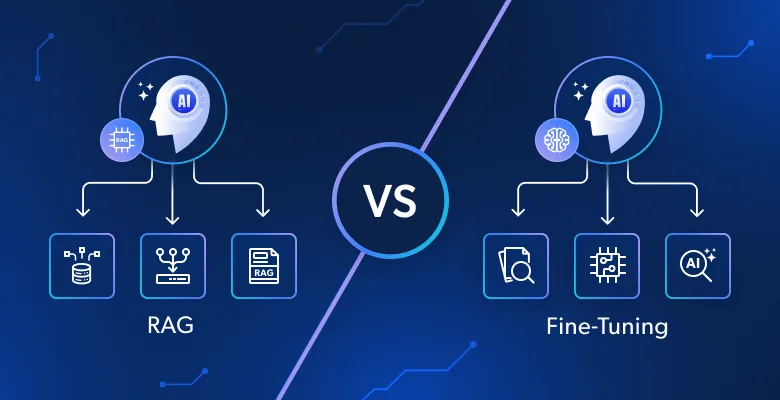
Every week, someone asks me whether they should use RAG or fine-tuning for their AI application. It's a reasonable question, but it's also the wrong question in most cases. The better question is: what problem are you actually trying to solve? Because RAG and fine-tuning solve fundamentally different problems, and many teams waste months pursuing the wrong approach.
What RAG Actually Does
Retrieval-Augmented Generation is not a training technique. It's an architecture pattern. You keep your documents in a vector database, retrieve the most relevant ones at query time and inject them into the LLM's context window alongside the user's question. The model generates an answer grounded in those retrieved documents.
The key advantage of RAG is that it separates knowledge from the model. When your documents change, you don't retrain anything. You just update the index. When you need to add a new knowledge domain, you add more documents. This makes RAG ideal for applications where the knowledge base changes frequently, or where you need to cite sources for compliance or audit purposes.
We built an enterprise knowledge platform using RAG for a professional services firm with 15,000 employees. Their internal documentation changed daily, with new policies, updated procedures, and project post-mortems. Fine-tuning would have required retraining every time a document changed. With RAG, we just re-index the affected documents. The system serves 8,000 active users with sub-second response times and cites sources for every answer.
What Fine-Tuning Actually Does
Fine-tuning modifies the model's weights by training it on your data. This changes the model's behavior, tone and knowledge in a way that's persistent. Once fine-tuned, the model internalizes patterns from your training data and applies them to every query, regardless of context.
Fine-tuning is best suited for tasks that require consistent behavior or style rather than access to specific documents. If you need your model to output JSON in a specific schema, follow a particular tone of voice, or understand domain-specific terminology, fine-tuning is likely the right approach.
For example, we fine-tuned a model for a healthcare client that needed to extract structured data from clinical notes. The model needed to understand medical terminology, follow a specific output schema and recognize patterns like medication names and dosages. Fine-tuning on de-identified clinical notes produced much better results than RAG could, because the knowledge was about how to interpret the notes, not about accessing specific documents.
When to Use Each Approach
After building both RAG and fine-tuned systems for clients across healthcare, finance and legal domains, here's how I think about the decision:
Use RAG when: your knowledge base changes frequently, you need to cite sources, you have diverse documents that don't fit neatly into a structured format, or you need to enforce access controls at the document level. Use fine-tuning when: you need consistent output formatting, your task requires domain expertise that's stable over time, you want to reduce latency by avoiding retrieval lookups, or you need the model to behave in a specific way regardless of context.
In many production systems, the right answer is both. We've built several applications that use fine-tuning to handle formatting and behavior, then RAG to supply relevant context. The fine-tuned model handles the 'how' while RAG handles the 'what.'
Common Mistakes We See
The most common mistake is teams spending months fine-tuning a model when RAG would have worked. Fine-tuning requires significant engineering effort: curating training data, managing training runs, evaluating output quality and maintaining versioning. If your use case only needs to ground responses in specific documents, start with RAG. It's cheaper, faster and easier to iterate on.
The second most common mistake is assuming RAG is simple. A production RAG system involves chunking strategies, embedding model selection, hybrid search (vector + keyword), re-ranking, context window management and prompt engineering. Each of these decisions affects output quality. We've seen teams give up on RAG because they used a naive implementation and got poor results, when a more sophisticated approach would have worked.
The third mistake is ignoring evaluation. Whichever approach you choose, you need systematic evaluation. We use a combination of automated metrics and human evaluation to measure answer accuracy, source relevance and hallucination rate. Without evaluation, you're flying blind.