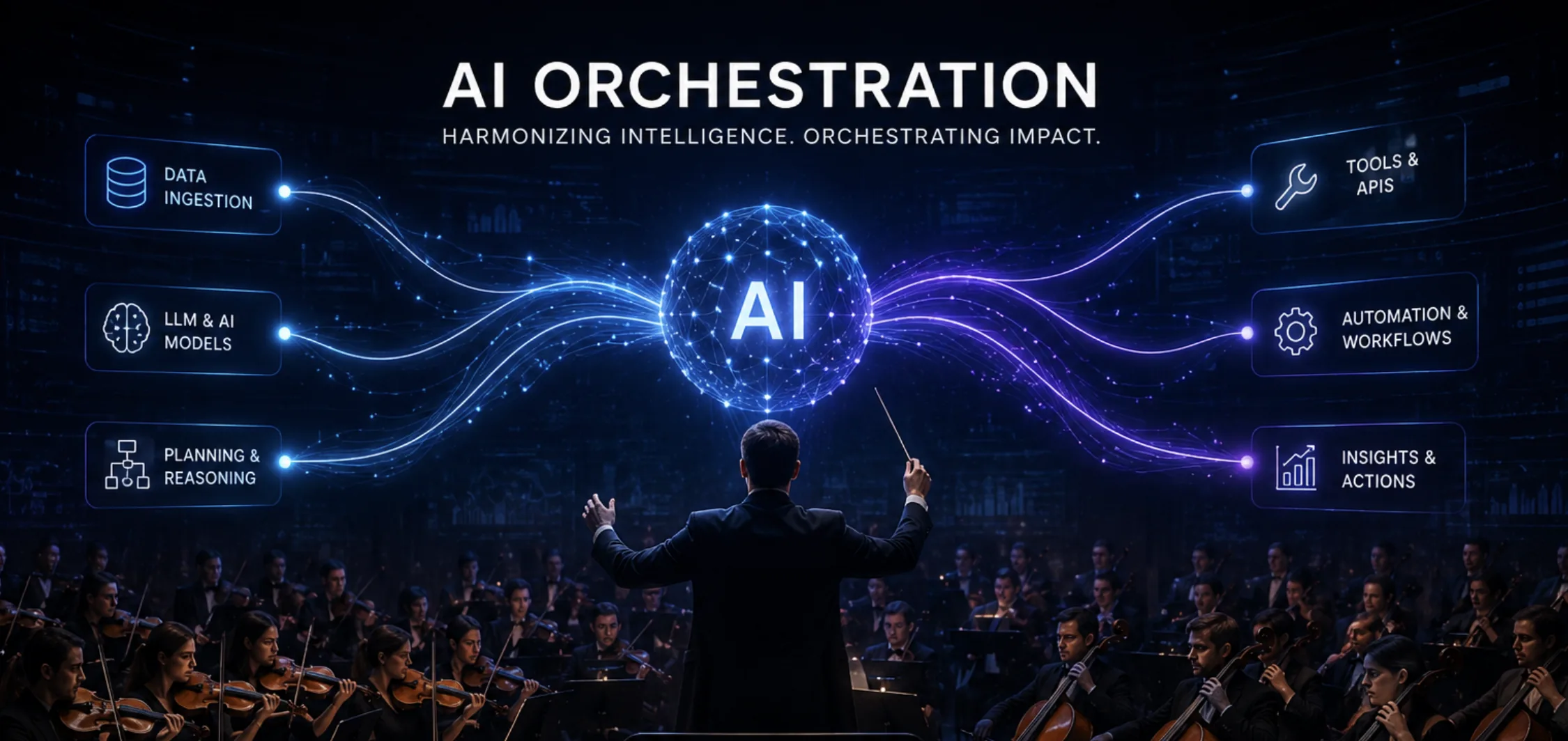
Every enterprise AI team eventually hits the same wall. You build a single agent, it works beautifully for the demo, and then you deploy it to production. Within weeks, the requirements start piling up. The agent needs to check inventory before answering a customer query. It needs to pull data from three different APIs. It needs to validate outputs against a compliance ruleset before sending anything to the customer. And suddenly your elegant single-agent system is a tangled mess of conditional logic, tool calls and error handling that nobody wants to maintain.
This is the orchestration problem. It is the central engineering challenge of 2026, and it is the reason the most capable AI systems in production today are not single models doing everything, but coordinated teams of specialized agents working together. Let me break down what AI orchestration actually means, how the architectures work and where this is all heading.
Why Single-Agent Systems Hit a Ceiling
The fundamental limitation of a single agent is context window saturation. Every tool definition, every system prompt, every retrieved document, and every conversation turn consumes tokens. When you try to give one agent the ability to search a database, call external APIs, generate code, validate compliance and talk to customers, you end up with a prompt that fills half the context window before the user even says anything.
We saw this with a financial services client last quarter. Their original design had one agent handling everything: account inquiries, transaction disputes, fraud detection and regulatory reporting. The agent's system prompt was 8,000 tokens. It had 15 tool definitions. Performance was acceptable for simple queries, but accuracy dropped sharply for complex multi-step workflows. The agent would sometimes skip validation steps, mix up tool call sequences or lose track of earlier conversation context.
The fix was not a bigger model or a longer context window. The fix was decomposition. We broke the monolithic agent into four specialized agents: an intake agent that classified intent, a routing agent that determined which specialist should handle the request, domain agents for transactions, fraud and compliance, and a coordinator that managed the workflow between them. Accuracy went from 72% to 94% on complex queries. Latency actually improved because each agent's prompt was focused and small.
What AI Orchestration Actually Means
AI orchestration is the discipline of coordinating multiple AI agents, tools and data sources to accomplish complex workflows that no single agent could handle reliably. It is not just about calling multiple tools from one agent. It is about designing systems where specialized agents collaborate, share state, handle failures gracefully and produce coherent outputs across multi-step processes.
Think of it like a hospital. You do not want one doctor doing everything. You want a triage nurse who assesses the situation, specialists who handle specific domains, a coordinator who ensures information flows between them and a quality process that catches errors before they reach the patient. AI orchestration applies the same principles to intelligent systems.
The key distinction is between tool orchestration and agent orchestration. Tool orchestration is when one agent calls multiple APIs or functions in sequence. That is relatively straightforward. Agent orchestration is when multiple autonomous agents, each with their own reasoning capability, collaborate on a shared task. That is where the real engineering complexity lives.
The Core Architecture Patterns
After building orchestrated AI systems for clients across healthcare, finance and logistics, we have settled on four architecture patterns that work reliably in production. Each solves a different class of problem, and most real systems combine two or three of them.
The Supervisor Pattern
The simplest orchestration pattern is the supervisor. A coordinator agent receives the user's request, determines which specialist agent should handle it, delegates the work and collects the result. The supervisor does not do the work itself. It manages the workflow.
This pattern works well when tasks are relatively independent and can be handled by a single specialist. A customer support system might have a supervisor that routes to billing, technical support, or account management specialists. Each specialist handles its domain independently. The supervisor's job is routing and escalation.
The limitation is that the supervisor pattern does not handle tasks that require collaboration between specialists. If answering a customer query requires both checking billing history and running a technical diagnostic, the supervisor needs additional logic to coordinate between the two specialists and merge their outputs.
The Pipeline Pattern
The pipeline pattern chains agents in a sequence where each agent's output becomes the next agent's input. This is ideal for workflows with clear stages: extract data, transform it, validate it, enrich it, and deliver the result.
We built a document processing pipeline for a legal firm that follows this pattern exactly. The first agent extracts structured data from unstructured contracts. The second agent validates the extracted fields against a rules database. The third agent flags potential compliance issues. The fourth agent generates a summary report. Each agent is specialized for its stage, with its own prompt, tools and validation logic.
The pipeline pattern's strength is predictability. Each stage is well-defined and testable in isolation. Its weakness is that it does not handle branching or conditional logic well. If the validation agent finds an issue that requires going back to the extraction stage, you need additional control flow logic that starts to resemble a directed acyclic graph.
The DAG Pattern
When workflows involve branching, parallel execution and conditional merging, a directed acyclic graph pattern is the right approach. Each node in the graph is an agent or a task. Edges define the flow of data between nodes. The orchestrator manages execution order, handles parallel branches and merges results.
We use this pattern for complex approval workflows. A request enters the system and is evaluated by multiple agents in parallel: a risk assessment agent, a compliance agent and a budget agent. Each produces a verdict independently. A coordinator agent collects all three verdicts and makes a final decision based on the combined assessment. If any agent flags a critical issue, the workflow branches to a human review step.
The DAG pattern is powerful but requires careful state management. Each agent needs access to shared context, but you also need to prevent agents from interfering with each other's state. We handle this by giving each agent a read-only view of the shared state and a private working memory for intermediate results. The coordinator merges private results into the shared state at well-defined synchronization points.
The Evaluator-Optimizer Pattern
This pattern is for tasks that require iterative refinement. A generator agent produces an output. An evaluator agent assesses the output against quality criteria. If the output does not meet the bar, the evaluator provides feedback and the generator tries again. The loop continues until the output passes or a maximum iteration count is reached.
We use this for code generation, content creation and data transformation tasks where quality matters more than speed. The generator might be a code-writing agent. The evaluator runs tests, checks lint rules and reviews security patterns. If anything fails, the evaluator sends specific feedback back to the generator with the error messages and relevant context. The generator revises its output based on the feedback.
The critical design decision is setting the evaluation criteria precisely enough that the loop converges. Vague criteria like 'make it better' lead to infinite loops or oscillating outputs. Specific criteria like 'all tests pass, no lint errors, no hardcoded secrets' give the evaluator clear signals and the generator clear targets.
State Management Is the Hard Part
Every orchestration pattern eventually confronts the same challenge: how do agents share state without stepping on each other? This is not a theoretical concern. We have debugged production incidents where two agents wrote conflicting values to the same shared object, causing downstream agents to process corrupt data.
The approach that works is treating agent communication as a message-passing system rather than shared memory. Each agent receives an input message, processes it and produces an output message. The orchestrator routes messages between agents. No agent writes directly to shared state. The orchestrator is the sole entity responsible for updating the shared context based on agent outputs.
This introduces some overhead. Message serialization and deserialization take time. But the reliability benefit is enormous. When something goes wrong, you can trace the exact message flow, see which agent produced bad output and diagnose the failure without reasoning about concurrent state mutations.
Tool Orchestration at Scale
Beyond agent-to-agent coordination, there is the challenge of tool orchestration. When an agent has access to 20 or 30 tools, the model needs to select the right tool, format the parameters correctly, handle errors and retry when appropriate. This is harder than it sounds, especially when tools have overlapping capabilities or dependencies.
We organize tools into three tiers. Core tools are always available: database queries, API lookups, search. These are defined in every agent's prompt. Specialized tools are available only to specific agents: a fraud detection agent gets access to risk scoring APIs that a billing agent does not need. And privileged tools require explicit approval: any tool that modifies external state, sends emails or triggers payments goes through an approval gate before execution.
The tool selection problem is where function calling quality varies dramatically between models. In our testing, GPT-4o and Claude 3.5 Sonnet handle 15-20 tool definitions reliably. Beyond 25 tools, accuracy drops noticeably. The mitigation is to give each agent a focused set of tools rather than exposing every tool to every agent. A routing agent might have 5 tools. A domain specialist might have 8-10. No single agent should need 30 tools.
Observability: The Non-Negotiable
Multi-agent systems are opaque by default. When a user gets a wrong answer, you need to know which agent produced the error, what inputs it received, what reasoning it followed and where it went wrong. Without observability, debugging a multi-agent system is like debugging a distributed system with no logs: technically possible but practically painful.
We instrument every agent interaction with structured logging. Each log entry captures the agent identifier, input messages, output messages, tool calls made, tokens consumed, latency and any errors. We aggregate these logs into a trace that shows the full execution path from user input to final output.
The tool we have found most valuable is not a specific observability platform but a simple principle: every agent must produce a structured reasoning trace that explains what it did and why. This trace is logged alongside the agent's output. When debugging, you can follow the reasoning chain from the coordinator down through each specialist to understand exactly how the system arrived at its answer.
Failure Modes and Recovery
Multi-agent systems fail in ways that single-agent systems do not. An agent might time out. An agent might produce malformed output that breaks downstream parsing. An agent might hallucinate tool calls to non-existent APIs. Two agents might enter a loop where each triggers the other indefinitely.
The recovery patterns we use are circuit breakers, fallback agents and dead letter queues. Circuit breakers stop calling an agent after repeated failures and route to a fallback. Fallback agents are simpler, more conservative versions of the primary agent that handle the same task with reduced capability but higher reliability. Dead letter queues capture messages that could not be processed, allowing offline analysis and retry.
The most important recovery pattern is graceful degradation. When the compliance agent in a financial workflow times out, the system should not block the entire request. It should proceed with a conservative estimate, flag the output for manual review and log the timeout for investigation. The customer gets a response. The compliance team gets an alert. The system does not break.
When Orchestration Is Overkill
Not every AI application needs orchestration. If your use case is a straightforward question-answering system, a single well-prompted agent with RAG is sufficient. If your workflow has fewer than three steps and does not require multiple specialized capabilities, adding orchestration overhead will slow you down without improving quality.
The decision framework is simple. If a single agent can handle the task with more than 90% accuracy using its available context window and tools, you do not need orchestration. If the task requires multiple specialized capabilities, complex validation, or coordination between different data sources and business rules, orchestration will improve both reliability and maintainability.
The middle ground is what we call lightweight orchestration: a single agent with a structured workflow engine that manages state and tool sequencing without introducing multiple agents. This is appropriate when the task is complex but the reasoning requirements do not vary across steps. The agent follows a fixed workflow rather than making autonomous routing decisions.
The Infrastructure Layer
Building orchestrated AI systems requires infrastructure that most teams do not have on day one. You need a message bus for agent communication, a state store for workflow persistence, a tool registry for managing function definitions and access control, and a monitoring layer for tracing execution.
The framework landscape is maturing rapidly. LangGraph provides a graph-based execution model that maps naturally to DAG orchestration patterns. CrewAI offers a higher-level abstraction for team-based agent collaboration. AutoGen from Microsoft focuses on conversational multi-agent patterns. Each has tradeoffs in flexibility, performance and operational complexity.
Our recommendation is to start with the simplest framework that meets your needs and be prepared to replace it. The orchestration space is evolving so fast that the framework you choose today will likely not be the one you use in eighteen months. What will persist is the architectural patterns: supervisor routing, pipeline chaining, DAG execution and evaluator loops. These patterns are framework-agnostic and will remain relevant regardless of which tools win the current round of competition.
What Comes Next
The next frontier is adaptive orchestration, where the system itself decides how to decompose tasks and which architecture pattern to apply. Instead of engineers designing the workflow graph, the system analyzes the task, determines the optimal decomposition and assembles the agent team dynamically.
We are seeing early versions of this in research. A coordinator agent receives a complex task, breaks it into subtasks, determines which subtasks can run in parallel and which have dependencies, assigns each subtask to a specialist agent and monitors progress. If an agent fails, the coordinator reassigns the task or modifies the plan. The engineering team defines the available agents and their capabilities. The system defines the workflow.
This is not science fiction. We are building early implementations for clients right now. The coordinator agent uses a planning model to generate a workflow graph, executes it using the patterns described in this article and adapts in real time based on agent outputs. The human engineer's role shifts from workflow designer to system architect: defining the agent roster, the tool ecosystem and the quality criteria, then letting the system figure out how to combine them.
The implications are significant. Development velocity increases because adding a new capability means adding a new agent to the roster, not redesigning the entire workflow. Reliability improves because the system can route around failures dynamically. And the barrier to building complex AI applications drops because the orchestration logic is generated, not hand-coded.
The teams that invest in orchestration infrastructure today will be best positioned to take advantage of these adaptive systems as they mature. Start with a solid foundation: structured agent communication, comprehensive observability, robust error handling and clear separation between orchestration logic and domain logic. The future of AI is not single models doing everything. It is coordinated teams of specialized agents, orchestrated intelligently, failing gracefully and learning continuously.