Fintech Fraud Detection Engine
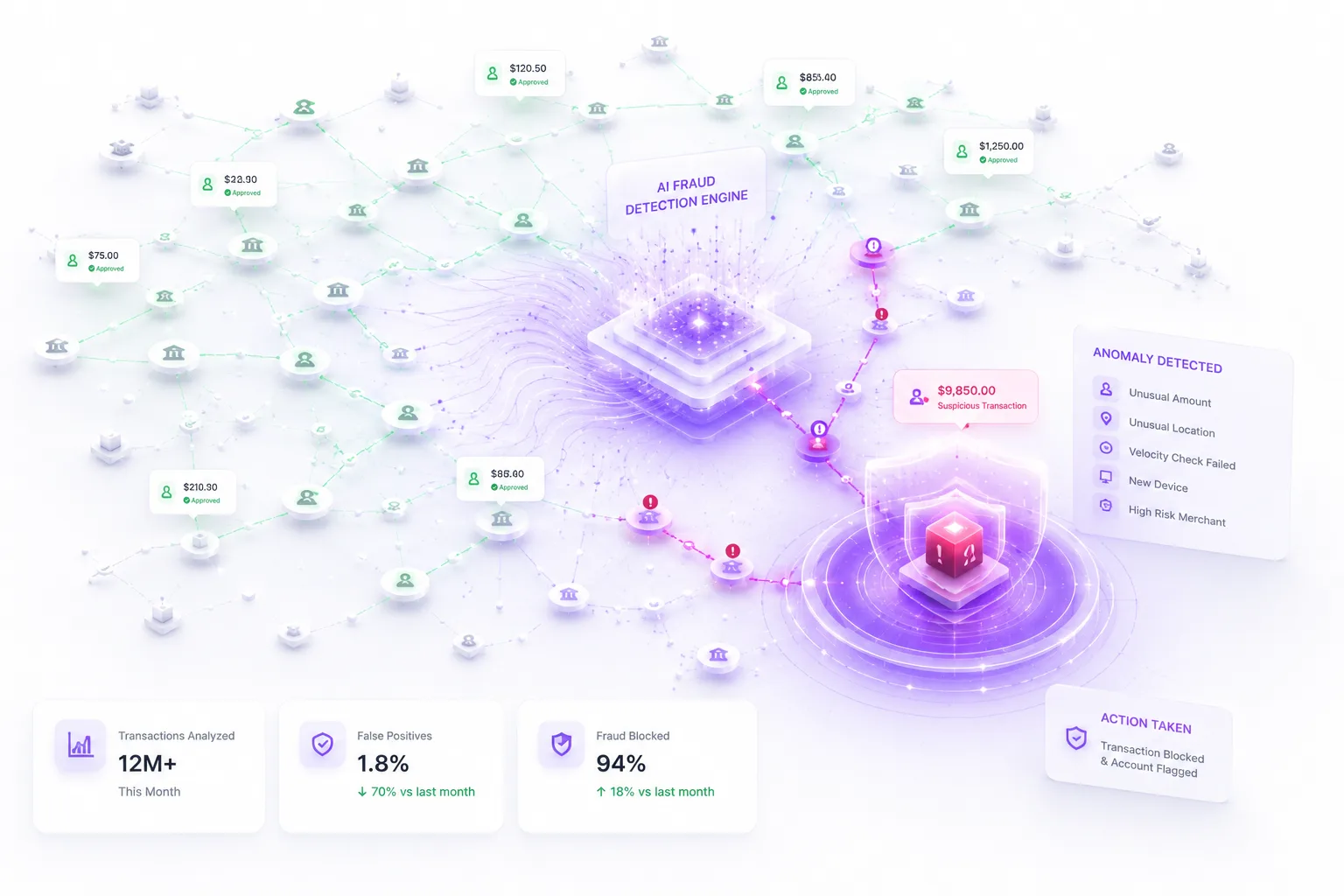
A growing fintech startup processing $50 million in monthly transactions was using a rules-based fraud detection system that flagged over 12% of legitimate transactions as suspicious. Each false positive required manual review, which cost the company in customer frustration and operational overhead. Meanwhile, real fraudsters were slipping through because the static rules couldn't adapt to new attack patterns fast enough. The company needed a system that could learn from transaction patterns and reduce false positives without sacrificing detection accuracy.
Challenge
A growing fintech startup processing $50 million in monthly transactions was using a rules-based fraud detection system that flagged over 12% of legitimate transactions as suspicious. Each false positive required manual review, which cost the company in customer frustration and operational overhead. Meanwhile, real fraudsters were slipping through because the static rules couldn't adapt to new attack patterns fast enough. The company needed a system that could learn from transaction patterns and reduce false positives without sacrificing detection accuracy.
Solution
We designed and deployed a hybrid fraud detection system that combined traditional rules with machine learning models. The ML layer used gradient-boosted decision trees and a graph neural network to analyze transaction patterns, device fingerprints, user behavior sequences and merchant relationships. We trained the models on three years of historical transaction data comprising 12 million transactions. The system included an automated feedback loop: when manual reviewers overturned a model decision, the model would retrain overnight to incorporate that correction. We deployed the system to handle real-time scoring with a 99th percentile latency of 47 milliseconds.
Outcome
False positive rate dropped from 12% to 1.8%. Actual fraud detection rate increased from 76% to 94%. The company's manual review team was redeployed from checking 1,200 alerts per day to investigating only the highest-risk 150. Estimated fraud losses decreased by $410,000 in the first six months. The system now processes over 2 million transactions per day.
Technology Stack
Architecture
Transaction Stream → Feature Pipeline → ML Scoring → Rules Engine → Decision → Feedback LoopReady to Build Something Exceptional?
Let's discuss how Aloha Studio can help you design, engineer and scale your next digital product.